Abstract
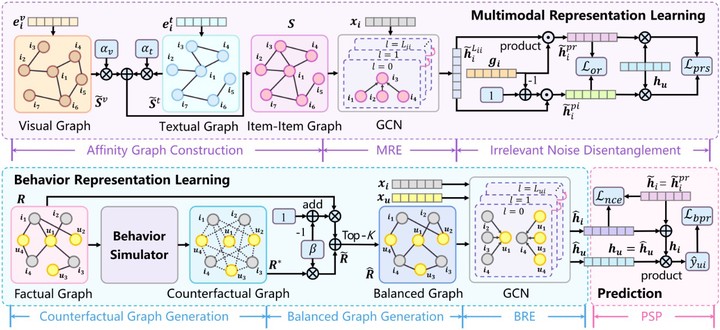
Recently, graph convolutional network-based dual-view multimodal recommendation methods have achieved great success. They extract multimodal and behavior features based on item-item and user-item graphs, respectively. However, they still have two-fold limitations. First, the relevance between multimodal semantics and user preferences is ignored, resulting in the propagation and coupling of preference-irrelevant noise. Second, the direct use of uneven factual user-item graphs is suboptimal, as both redundant noisy edges and missing positive interaction edges impair recommendations. To solve the above issues, we propose a DisentAngled deNoising and Counterfactual balancE method for multimodal recommendation, dubbed as DANCE. Specifically, for multimodal features, we explicitly disentangle them into preference-relevant and preference-irrelevant representations, to absorb and discard irrelevant noise via the latter. An orthogonal regularization and a contrastive learning task on preference relevance score prediction are proposed as the dual safeguard to prevent preference-relevant representations from encoding irrelevant noise. For behavior feature extraction, we construct a balanced user-item graph by integrating factual and counterfactual graphs. In this process, we pre-train a behavior simulator to build the counterfactual graph with full interactions. Top-K sampling is adopted to omit noisy edges and add missing edges in the graph. The final recommendation is performed upon the fused representation of preference-relevant multimodal and behavior representations. Extensive experiments on three public datasets verify the power of our DANCE.
